
The Conversation Funnel: Rebuilding the Marketing Journey for the AI Era
Today, the customer journey is increasingly starting inside AI search engines, where users ask questions, refine intent, compare options, and validate decisions before they ever click.
January 2026 made this shift impossible to ignore.
OpenAI publicly outlined plans to test advertising in ChatGPT (for logged-in adults in the U.S. on Free and Go tiers), with ads displayed separately at the bottom of answers when relevant, and with explicit principles around answer independence and conversation privacy.
At nearly the same moment, Google leadership reiterated that the Gemini app will not have ads, even while Google continues monetizing through Search experiences like AI Overviews and AI Mode testing.
The result is a new marketing reality: conversation is now the funnel, and platforms are choosing different rules for how (or whether) paid media enters that funnel.
Key takeaway: In 2026, a modern AI search strategy must account for two parallel layers:
- Organic conversation visibility (whether AI assistants surface, cite, or recommend you)
- Sponsored conversation placements (where paid units appear adjacent to AI answers in some assistants)
This article introduces the concept of the "Conversation Funnel" as a new marketing funnel model designed for generative search. It also provides a practical operating system for execution: Primacy’s AIR Framework.
Table of Contents
- 1) What is the Conversation Funnel?
- 2) Why the classic funnel breaks in generative search
- 3) The AIR Framework: Authority, Intent, Relationship
- 4) Intent in the age of AI: Query fan-out
- 5) Authority: Teaching AI to trust you
- 6) Relationship: Sustaining dialogue beyond the click
- 7) Sponsored Conversation: The paid layer inside the Conversation Funnel
- 8) Measurement and attribution for AI referrals and ChatGPT Ads
- 9) Implementation roadmap
- 10) FAQ
1. What is the Conversation Funnel?
The Conversation Funnel is a marketing model that reflects how people increasingly make decisions: they start by asking an assistant, refine with follow-up questions, validate options, and only then click to act. In other words, conversation becomes the journey, and traffic becomes the residue of that journey.
If you have ever seen traffic arriving with utm_source=chatgpt, you have seen the Conversation Funnel in the wild. That visitor is often not “cold.” They have already:
- Asked a question and received a synthesized answer
- Explored alternatives and tradeoffs through follow-up prompts
- Formed a preference set before landing on your site
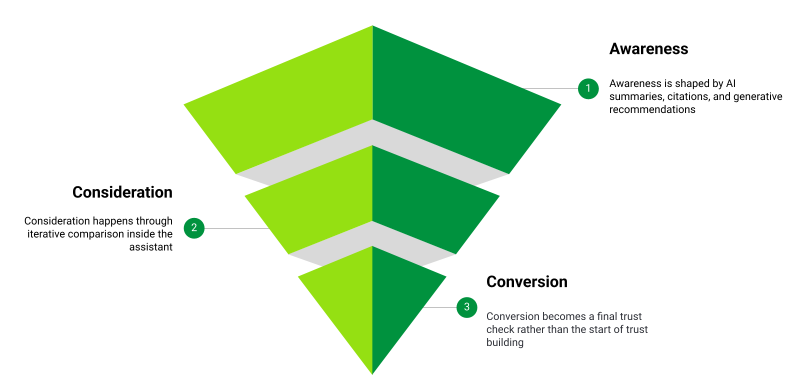
The Conversation Funnel maps cleanly to the classic stages, but the mechanics are different:
- Awareness is shaped by AI summaries, citations, and assistant recommendations
- Consideration happens through iterative comparison inside the assistant
- Conversion becomes a final trust check rather than the start of trust building
This reframing is the foundation for a modern ChatGPT strategy and broader AI search strategy.
2. Why the classic funnel breaks in generative search
Traditional SEO and analytics were built for a world where “search” meant ten blue links, a click, then a session. Generative search changes the shape of discovery in three ways.
AI intermediates discovery
AI search engines and assistants can answer questions directly, summarizing multiple sources into one response. This changes where value is created. You can “win” the conversation and still not receive the click.
Intent expands inside the assistant
In classic SEO, intent was often approximated by keyword grouping. In generative search, a single question can unfold into many follow-up questions. This is where query fan-out becomes essential (we will go deep on it later).
Monetization strategies diverge
The advertising layer is no longer uniform. OpenAI has articulated a plan to test ads in ChatGPT with strict principles: ads are separate, labeled, and do not influence answers, and user conversations are not sold to advertisers. Google, meanwhile, has reiterated that Gemini will not have ads inside the app, emphasizing trust. Whether you like ads or not, the operational reality is that your marketing funnel now has both organic and sponsored conversational surfaces.
Strategic implication: If you only optimize for rankings and clicks, you are optimizing for the last mile. The Conversation Funnel forces you to optimize earlier, where preference formation happens.
3. The AIR Framework: Authority, Intent, Relationship
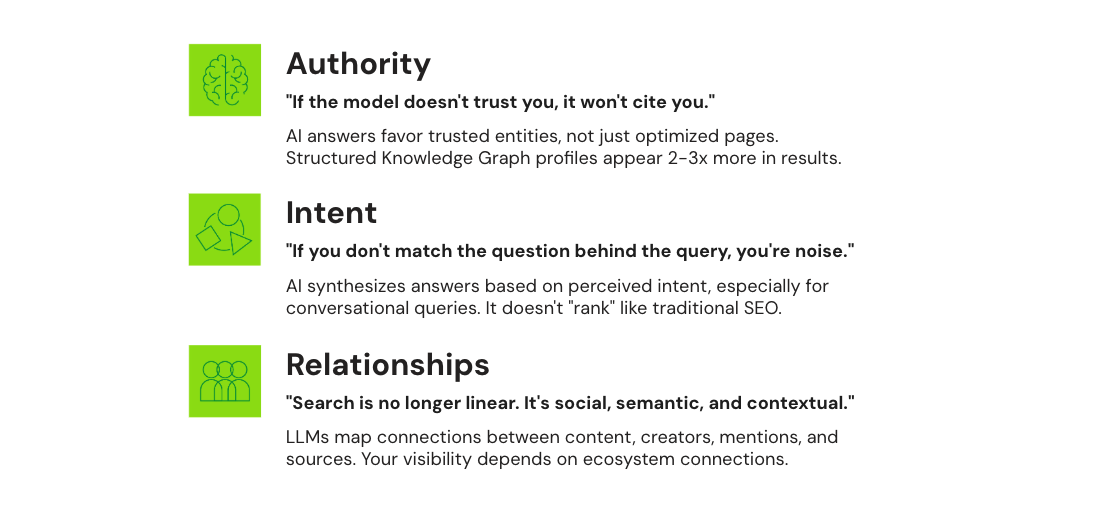
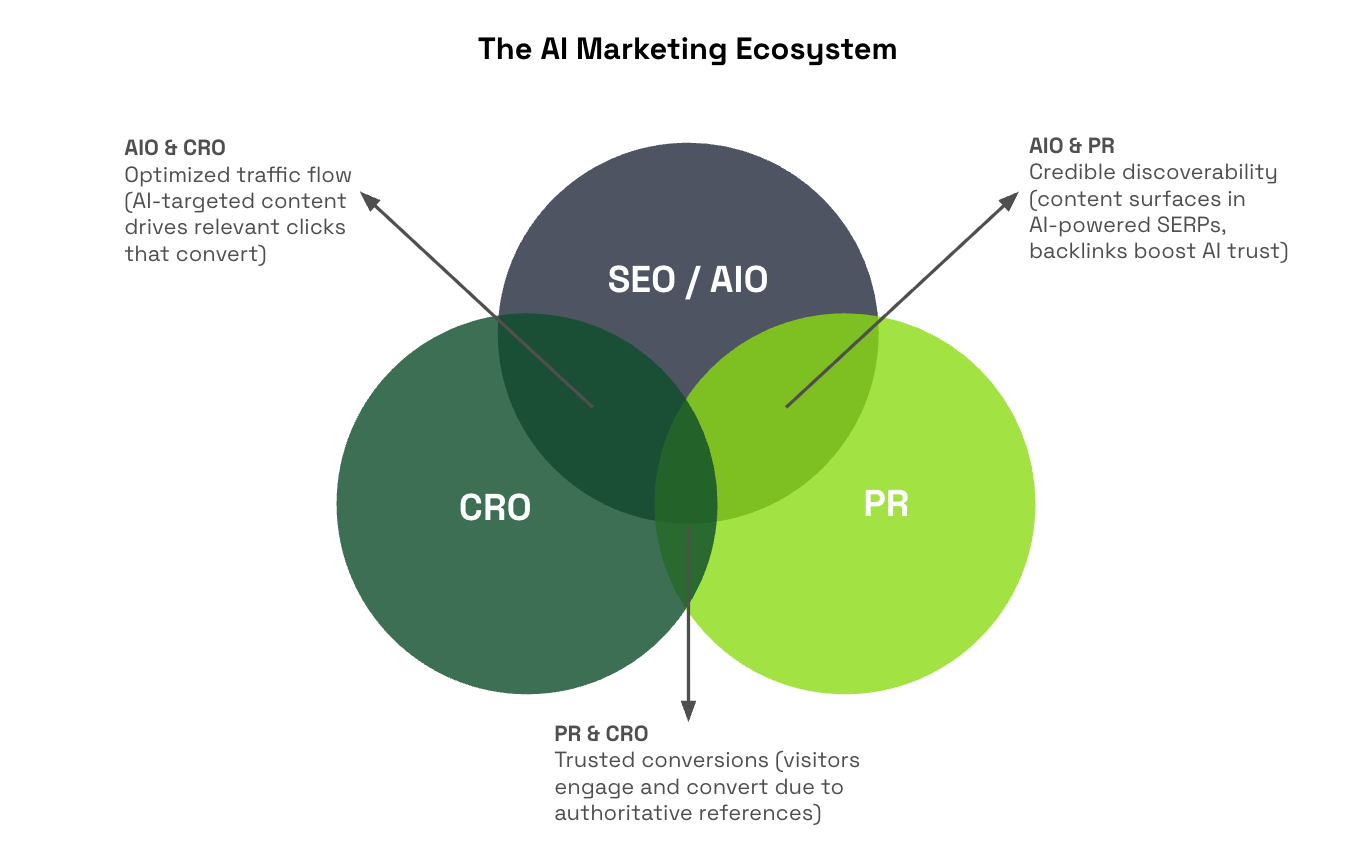
To operationalize the Conversation Funnel, Primacy uses an execution framework we call AIR: Authority, Intent, and Relationship. AIR is a practical model for aligning content, technical SEO, PR, CRO, and Analytics with how AI-driven discovery works.
Authority
Authority is how an assistant decides you are credible enough to cite, recommend, or reference. In an AI-mediated world, authority is no longer just “domain authority.” It is entity clarity, expertise signals, topical depth, and trust reinforcement.
Intent
Intent is how you model what the user actually needs, including the next questions they will ask. Intent in generative search is not a single keyword. It is a network of follow-ups driven by query fan-out.
Relationship
Relationship is what happens after the assistant introduces you. If the first touch is a summary, then your on-site and off-site experiences must continue the dialogue: micro-conversions, nurturing, community, and repeat engagement.
AIR overlays the funnel stages:
- Awareness: Authority + Intent determine whether you appear in AI responses
- Consideration: Intent + Relationship determine whether you stay in the decision set
- Conversion: Authority + Relationship determine whether you win trust at the moment of action
4. Intent in the age of AI: Query fan-out
If there is one concept that explains why the Conversation Funnel exists, it is this: AI systems expand intent. Your audience rarely asks one question. They ask one question, then eight more.
What is query fan-out?
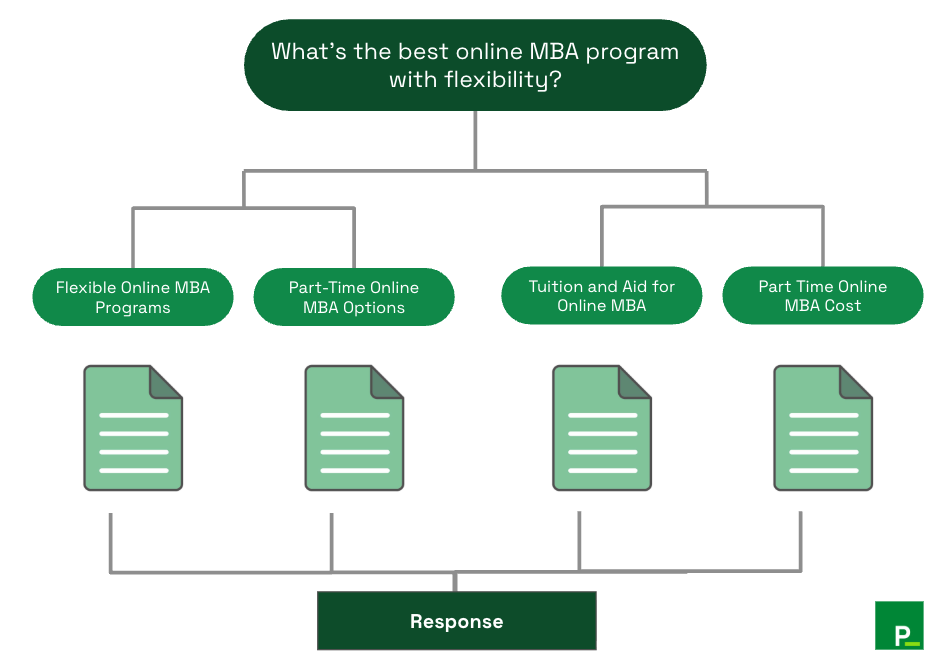
Query fan-out describes how AI search engines take a seed query and branch it into multiple related queries, often exploring definitions, comparisons, risks, costs, examples, and implementation steps. That fan-out is how the assistant assembles a response that feels complete.
Example seed query: “What is a conversation funnel?”
Likely fan-out queries:
- How is a conversation funnel different from a traditional funnel?
- What is the best AI search strategy for top-of-funnel visibility?
- How do AI search engines decide which sources to cite?
- How do I measure
utm_source=chatgpttraffic? - Do ChatGPT ads influence recommendations?
- How can brands show up in generative search without losing trust?
In classic SEO, you might write one page for one cluster. In generative search, you need coverage across the intent neighborhood.
Why query fan-out matters in the Conversation Funnel
Query fan-out changes the job of content. Your content is not only trying to rank. It is trying to be useful as a building block inside an AI-generated answer and inside the user’s decision journey.
- At Awareness: fan-out favors clear definitions, frameworks, and fast comprehension
- At Consideration: fan-out favors comparisons, scenarios, and “which option is best for me” logic
- At Conversion: fan-out favors validation, trust signals, proof, and risk reduction
What Semrush found in a query fan-out optimization experiment
Don't just take our word for it. Semrush ran an analysis: the results indicated that fan-out optimization can increase citations (early lift in citations), but also revealed high volatility in AI visibility metrics as platforms change citation behavior.
Practical takeaway:
- Query fan-out can improve discoverability and citation likelihood
- Visibility volatility is normal in AI systems and should be planned for
- Intent coverage matters more than a single “ranking” concept
How to apply query fan-out in your AI search strategy
Treat query fan-out like a repeatable workflow:
- Pick your seed topics (the terms you want to own, such as “conversation funnel”).
- Generate fan-out queries using tools and human review.
- Map queries to funnel stages (Awareness, Consideration, Conversion, plus Sponsored Conversation).
- Expand content with sections that directly answer the highest-value fan-out queries.
- Measure visibility using AI visibility tools plus on-site engagement and conversion metrics.
In AIR terms: query fan-out is the operational backbone of Intent. If you do not model fan-out, you do not control the conversation.
5. Authority: Teaching AI to trust you
If intent determines relevance, authority determines selection. AI systems tend to prefer sources that appear credible, consistent, and deeply informative. Authority is the difference between “mentioned” and “trusted.”
What authority looks like in generative search
- Entity clarity: consistent brand, author, and topic signals across the web
- Topical depth: a connected cluster of content, not one standalone post
- Expertise signals: clear authorship, credentials, references, and methodology
- Trust reinforcement: proof points, examples, and transparent claims
A critical shift in 2026: answer independence becomes the trust contract
OpenAI’s advertising principles make something explicit that marketers should internalize: assistants must preserve trust by keeping ads separate and ensuring ads do not influence answers. This raises the bar for authority. As sponsored placements appear in some assistants, organic visibility increasingly depends on being the most credible source in the answer layer.
How to build authority density around “Conversation Funnel”
If you want to own the term conversation funnel, you need more than one article. You need a small library that covers the intent neighborhood and interlinks as a cluster.
- Pillar: This article (foundational definition and operating model)
- Cluster content: query fan-out methods, AI search strategy playbooks, attribution guidance, CRO for AI traffic, ChatGPT Ads readiness
- Proof content: case studies, experiments, and frameworks like AIR
6. Relationship: Sustaining dialogue beyond the click
The Conversation Funnel does not end with a click. Often, the click is the start of the relationship layer after an assistant has already shaped the user’s beliefs. Your job is to continue the dialogue in a way that feels consistent with what the user just experienced in the assistant.
Relationship is the new conversion moat
In a world where answers are summarized upstream, durable advantage comes from what happens next: the experience you deliver, the credibility you reinforce, and the value you provide after the initial discovery moment.
Relationship tactics that work for AI-referred traffic
- Conversational landing pages: pages that confirm and extend what the user learned in the assistant
- Micro-conversions: checklists, templates, audits, interactive tools
- Nurture flows: email or CRM sequences tied to the fan-out questions the user likely explored
- Community and social proof: reviews, Q&A, and credible third-party validation
AIR makes this operational: relationship is how you convert an assistant introduction into repeat engagement and downstream revenue.
7. Sponsored Conversation: The paid layer inside the Conversation Funnel
The most important update to the Conversation Funnel in 2026 is the emergence of a fourth layer: Sponsored Conversation.
Historically, paid media sat outside the assistant. You bought search ads, social ads, programmatic ads, then drove clicks to a site. Now, some platforms will insert paid units inside the conversational experience, adjacent to the moment of intent formation.
What OpenAI’s ChatGPT Ads model suggests
OpenAI’s stated approach frames ads as:
- Clearly labeled and separate from answers
- Shown at the bottom of responses when relevant
- Governed by principles including answer independence and conversation privacy
- Controlled by the user (including the ability to turn off personalization)
Strategically, this creates a new insertion point that behaves less like classic display and more like contextual intent capture, occurring before a user chooses a site to visit.
Google’s counter-position: keep the Gemini assistant ad-free
Google’s public position is that the Gemini app has no ads and no current plans to add them. At the same time, Google continues to monetize AI-enhanced search experiences in other places, such as the SGE. For marketers, this means you must plan across:
- Assistant surfaces (Gemini app) where trust and utility are emphasized
- Search surfaces (AI Overviews, AI Mode testing) where monetization can occur
What changes when paid units enter conversation
- The moment of intent shifts earlier. The user is still forming preferences in the chat.
- Paid becomes mid-funnel. It influences consideration, not just demand capture.
- Trust becomes a performance variable. If users suspect bias, conversion friction rises.
- Measurement needs new taxonomy. Organic conversation visibility vs sponsored placements.
New rule: In a sponsored conversational world, you must win both layers. You must earn organic authority in the answer layer and build readiness for paid placements where available.
8. Measurement and attribution for AI referrals and ChatGPT Ads
Most teams fail here because they treat AI referrals like a curiosity rather than a channel. The Conversation Funnel requires a measurement model that distinguishes organic AI discovery from sponsored AI placements, then ties both to downstream outcomes.
Create three reporting buckets for AI
- AI organic referral: traffic from assistant links (example:
utm_source=chatgpt) - AI sponsored referral: traffic from paid units inside assistants (use a dedicated UTM convention)
- AI assisted conversions: users exposed in chat who convert later via other channels
Map KPIs to AIR
- Authority: citation share, brand mentions in AI answers, third-party references
- Intent: fan-out coverage, performance by intent cluster, content depth engagement
- Relationship: repeat visits, nurture engagement, conversion lag, cohort LTV
Add a “trust proxy” layer
When ads appear near AI answers, skepticism can show up as hesitation rather than immediate drop-off. Track trust proxies by cohort:
- Time to first meaningful action
- Conversion lag (days to convert)
- Return visits and repeat engagement
- Assisted conversion rate
Expect volatility
AI platforms are changing rapidly. Citation behavior can change without warning. Your measurement system should be designed to detect shifts early, not to assume stability.
9. Implementation roadmap
The Conversation Funnel becomes real when it is operationalized as a repeatable program. Here is a practical roadmap that teams can execute in phases.
Phase 1: Audit
- Inventory existing content for conversation readiness
- Identify seed topics you want to own (example: “conversation funnel”)
- Benchmark current AI visibility and referral patterns
Phase 2: Model intent with query fan-out
- Generate fan-out queries for each seed topic
- Classify fan-out queries by funnel stage
- Prioritize queries tied to revenue, pipeline, or strategic positioning
Phase 3: Expand and interlink content
- Update pillar and cluster content to directly answer fan-out queries
- Add structured FAQ blocks for AI-friendly retrieval
- Build internal linking that signals topical ownership
Phase 4: Add Sponsored Conversation readiness
- Define UTM conventions for AI sponsored placements
- Align landing pages to conversational intent, not just keywords
- Prepare governance for trust, brand safety, and sensitive topics
Phase 5: Instrument, learn, iterate
- Track AIR metrics, not only last-click conversions
- Review fan-out coverage quarterly as platforms evolve
- Publish experiments and findings to build authority and backlinks
The marketing teams that win the next decade will not be the teams who chase every platform shift. They will be the teams who build a durable system for how conversation shapes demand.
10. FAQ
What is the Conversation Funnel?
The Conversation Funnel is a new marketing funnel model where discovery and consideration increasingly happen inside AI assistants and generative search experiences, and where traffic is often the outcome of a prior conversation rather than the start of the journey.
What is query fan-out and why does it matter?
Query fan-out is the branching of one query into multiple related follow-up queries that AI systems use to assemble a complete answer. It matters because it shifts optimization from single keywords to coverage of an intent network that mirrors real decision-making.
How do ChatGPT ads affect marketing strategy?
Ads in ChatGPT introduce a Sponsored Conversation layer that can influence users while they are forming intent. This requires marketers to plan for both organic conversation visibility (authority in answers) and paid conversational placements where available.
How should I measure AI traffic like utm_source=chatgpt?
Segment AI organic referral traffic separately, track AI assisted conversions, and add AIR metrics such as citation visibility, fan-out coverage engagement, and relationship indicators like repeat visits and conversion lag.