
AI Marketing Ecosystem: SEO, PR, and CRO Integration
Marketing used to have clear lanes: SEO got you found, PR got you noticed, and CRO got you results. Those lanes? They’re disappearing. AI isn’t just changing the game, it’s tearing down the walls between visibility, reputation, and conversion. The smartest brands are now connecting these strategies into a single, seamless growth engine, using AI to guide every click, mention, and interaction.
As AI reshapes how audiences discover, evaluate, and engage with brands, integrating SEO, PR, and CRO has become a strategic imperative. AI-powered search like LLMs, Google Overviews, and AI Mode are compressing the traditional awareness stage, with users increasingly getting answers directly in search results rather than clicking through to websites.
This shift puts new pressure on each discipline. SEO must fight for attention and visibility in increasingly limited search real estate. CTRs are declining, making CRO more critical: the visitors who do reach the site need to convert efficiently. PR also grows in strategic importance, as authoritative references and backlinks influence which sources AI-powered systems surface and trust.
AI Enablement Best Practices Playbook
The Fusion of Disciplines: SEO, PR, & CRO
The old marketing funnel; SEO brings traffic, PR builds awareness, CRO drives conversions is breaking down. Now marketers have to understand how all three disciplines overlap throughout the customer journey.
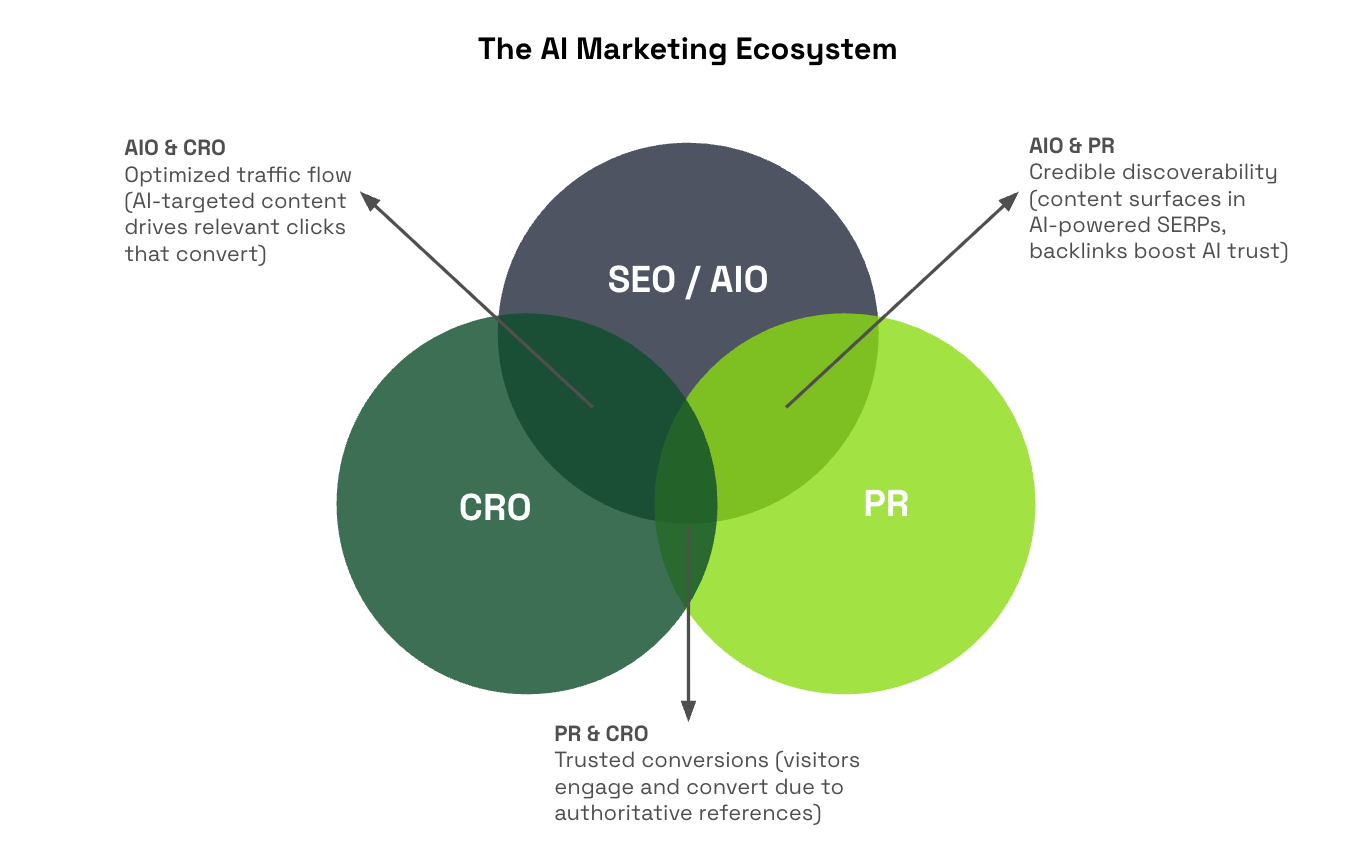
Train: Getting Your Content Noticed
AI-powered searches like LLMs, Google Overviews, AI Mode are compressing the traditional awareness stage. Users are getting answers without clicking through, so the usual SEO tactics aren’t enough. Now, content must be structured for AI readability (semantic clarity, factual accuracy) and supported by signals that AI trusts like authoritative mentions and backlinks creating a bridge between PR.
Trust: Keeping Users Engaged
For the visitors who do click, engagement isn’t just about good content, it’s about AI-aligned relevance. Behavioral insights from CRO now help shape content that keeps users interested and signals value back to AI systems. Trust signals from PR reinforce engagement and make AI more likely to continue surfacing your content.
Transact: Turning Visits into Action
Conversion is no longer only about forms or buttons. AI can pre-qualify users or highlight content most likely to resonate, meaning CRO, SEO, and PR need to coordinate. Conversion success depends on guiding already-filtered, credibility-weighted traffic where SEO brings context, PR builds trust, and CRO optimizes the experience.
Integrating the Ecosystem: Turning Channel Insights into Collective Intelligence
AI has made marketing data more connected than ever. But the real opportunity isn’t in having more signals, it’s in how those signals inform one another. When SEO, PR, and CRO operate as a learning loop rather than isolated tracks, every campaign trains the next one.

1. SEO Insights That Influence PR and CRO
Entity & Topic Signals: Beyond keywords, track topic clusters and emerging entities. PR can craft thought leadership that aligns with trending queries and semantic authority, positioning the brand as an expert in evolving areas.
Search Intent Patterns: Not just what users search, but why they search it. CRO can use this to anticipate user goals, prioritize content hierarchy, and personalize CTAs for intent-driven pathways.
Authority & Visibility Feedback: SEO tracks which content earns links, citations, and mentions. PR can amplify these assets, and SEO can refine strategies based on which topics or formats drive authority growth.
2. PR Insights That Inform SEO and CRO
Brand Sentiment & Messaging Resonance: Analyze not just mentions, but the emotional response and framing. SEO can adjust keyword tone, and CRO can test messaging that resonates most with target audiences.
Credibility Signals & Topic Validation: High-performing PR placements reveal the language and topics audiences trust. SEO can build authoritative clusters around these signals, while CRO experiments with the messaging in conversion flows.
Entity Reinforcement: PR helps reinforce brand associations in AI-driven search results. Consistent entity mentions increase discoverability, improve semantic relevance, and strengthen authority signals.
3. CRO Insights That Guide SEO and PR
Conversion Behavior Insights: Go beyond surface-level metrics. Identify which messages, visuals, and content structures reliably drive micro- and macro-conversions. A/B testing can validate which variations perform best, and SEO can integrate these learnings to optimize content structure and internal linking.
User Friction & Drop-Off Analysis: Heatmaps, session replays, and form analytics reveal why users disengage. PR can proactively address objections, while CRO can test friction reduction strategies.
Content Prioritization & Validation: CRO data shows which content truly drives value. SEO can adjust crawl priorities, internal linking, and content updates based on demonstrated user engagement and conversion paths.
Building the Feedback Loop
To make the most of an integrated AI marketing ecosystem, teams should start with a shared measurement framework, establishing cross-channel KPIs that track visibility, engagement, and conversion rather than evaluating each discipline in isolation. All SEO, PR, and CRO data should feed into a centralized layer, whether an AI model or a dashboard that can surface patterns and insights that might be missed when reviewing channels separately.
Each campaign iteration then becomes a source of “training data,” with SEO learning what drives visibility, PR refining strategies that build trust, and CRO improving actions that drive conversions, creating a continuous loop of improvement across disciplines.
Putting it Into Practice: An Integration Playbook
Step 1: Map the Journey

The first step is to understand your customer’s path from first discovery to conversion. Take a hard look at how people currently find your brand, how they evaluate it, and what actions lead them to convert. Map out each touchpoint; search, social mentions, PR coverage, landing pages, emails, or ads and note which discipline currently supports each stage.
Doing this reveals where your efforts overlap, where gaps exist, and which stages are under pressure from AI-driven behaviors, like answers surfacing directly in search results. This map becomes the foundation for aligning SEO, PR, and CRO in a way that reflects how users actually move through your ecosystem.
Step 2: Identify Cross-Channel Signals
Once you have mapped the customer journey, the next critical step is to look beyond the surface metrics and establish a connected feedback loop. Ask: What can one channel teach another?
Remember the feedback loop we talked about earlier? Let’s bring that back.
To break down silos, you need to track signals that have relevance across the entire ecosystem. Here are the core questions to start with and the insights they should generate:
1. SEO Insights That Influence PR and CRO
Start by looking at what the search engine ecosystem is validating.
Core Question: Which content is earning visibility, driving traffic, and achieving deep engagement?
Actionable Signal:Entity & Topic Signals. Beyond simple keyword tracking, identify which topic clusters and entities your content is ranking for. PR can use this to craft thought leadership and secure placements that reinforce your semantic authority in those trending areas. CRO can anticipate user goals based on search intent patterns and personalize CTAs for high-value pathways.
2. PR Insights That Inform SEO and CRO
PR insights reveal not just who is talking about you, but how they feel and what they trust.
Core Question: Which mentions and backlinks are building credibility and resonance?
Actionable Signal: Brand Sentiment & Messaging Resonance. Analyze not just the volume of mentions, but the emotional response and specific language used in high-authority placements. SEO can adjust the tone and framing of high-ranking content to match this trusted language. CRO can test messaging validated by PR to see if it increases conversions on key landing pages.
3. CRO Insights That Guide SEO and PR
CRO data provides the ultimate feedback loop: what actually drives value and revenue.
Core Question: Where do visitors drop off, and which messages reliably lead to conversion?
Actionable Signal: Conversion Behavior Insights. Go beyond form fills. Use A/B testing, session replays, and heatmaps to identify which content structures, visuals, and proof points reliably drive micro- and macro-conversions. SEO can integrate these learnings to optimize content hierarchy and internal linking. PR can use this data to proactively address customer objections revealed by user friction analysis.
Step 3: Run Experiments Across Channels
With your journey mapped and your cross-channel signals identified, the next step is to initiate controlled, small-scale tests that measure the collective impact of your integrated efforts. The goal here is to prove that a change in one channel leads to a measurable improvement in another.
Treat every experiment as training data for your unified marketing ecosystem.
SEO + PR Alignment Test:
Action: Update a piece of existing, high-ranking blog content (SEO) by embedding a recent, authoritative quote or reference from a successful PR placement (PR).
Measurement: Track the immediate change in Search Engine Results Page (SERP) ranking or visibility, and then monitor the conversion rate of visitors to that page (CRO) to see if the added authority improves transactional success.
PR + CRO Messaging Test:
Action: Take a specific phrase or benefit statement that resonated most powerfully in a recent PR campaign (e.g., in a trusted news article) and use it to test a new call-to-action (CTA) or headline on a high-traffic landing page (CRO).
Measurement: Track lift in conversion rate and, crucially, measure the resulting increase in time on page or decrease in bounce rate (SEO behavioral signal) to see if the resonant messaging keeps users engaged.
CRO + SEO Structural Test:
Action: Based on a CRO drop-off analysis showing users stop engaging after the third content section, rearrange the internal linking structure on that page to push traffic to a related, high-authority cluster (SEO).
Measurement: Analyze if the change reduces drop-off and if the linked page earns higher visibility or domain authority growth (PR signal via increased link equity distribution).
Document results and iterate. These cross-channel experiments validate your assumptions, provide concrete evidence for resource allocation, and ensure that lessons learned in one area immediately benefit the others.
Step 4: Prioritize High-Impact Actions
An integrated ecosystem generates a wealth of new insights, but attempting to act on everything at once leads to wasted effort. The final step in your playbook is to move away from isolated channel to-do lists.
Not everything can be optimized at once. Focus your resources first on opportunities that satisfy at least two of the following high-impact criteria:
Mass Reach Potential (SEO/PR): Focus on the content and topics that either rank highly now or have the best chance to capture significant search volume and attract valuable brand mentions. Prioritize optimizing these assets first, as they reach the largest audience base.
Influence on Trust and Authority (PR): Target areas where a small change can significantly improve credibility. This includes ensuring your highest-ranking pages feature validated PR messaging and trusted third-party signals. If an action strengthens your authority in the eyes of both users and AI, prioritize it.
Biggest Conversion Impact (CRO): Identify the pages or processes with the highest drop-off rate or the highest potential revenue gain. When optimizing these critical conversion points, ensure your changes are informed by SEO intent and PR trust signals.
The Next Era of Growth is Unified
The lines between SEO, PR, and CRO are dissolving. Traffic without trust is useless, and credibility without conversion is a wasted opportunity.
The true transformation isn't about using a new set of tools; it’s about connecting the signals to create a single, smarter growth engine. When your link-building informs your content structure, and conversion insights dictate your messaging, you stop running disconnected campaigns and start training a continuous feedback loop.
The future of digital growth isn't about doing SEO, PR, and CRO well; it's about making them inseparable.