
The 70,000-Mention Gap: A Comparative Analysis of Yale’s AI Visibility

- Authority ≠ Visibility: Yale has the credibility, but lacks the volume AI models rely on
- 70,000-Mention Gap: A significant deficit in AI-driven share of voice
- Frequency Wins: Consistent, structured content outweighs isolated high-quality assets
- “Always-On” Advantage: Competitors generate more citable, real-time data signals
To close the gap, Yale must shift toward AI Optimization (AIO), building a larger, structured digital footprint that ensures it shows up consistently in AI-generated answers.
Yale University's brand remains one of the most authoritative in the world. But in AI-mediated discovery, it's becoming absent from the answers that shape student consideration.
Download Our Enterprise AI Enablement Best Practices Playbook
The Ivy League Visibility Landscape
When you look at the Ivy League, a few names are practically impossible to miss. Harvard pops up everywhere, Princeton is quietly building authority, and Columbia has a knack for landing stories that get people talking. Yale, by comparison, tends to blend into the background. The school produces incredible work, but online, it doesn’t always show up where it counts.
Search results, press mentions, and visible thought leadership all paint a picture. Harvard dominates headlines, Princeton steadily climbs in recognition, and Columbia manages to make even small projects look like big news. Yale produces comparable results behind the scenes, but fewer people notice. Making sure the world sees what you’ve already done. A small push in visibility could make a huge difference in reputation, engagement, and influence.
The Authority Paradox
In the legacy world of Search Engine Optimization (Backlink counts, Domain Authority, and PageRank), Yale is an undisputed heavyweight. With an Authority Score of 75, they possess the digital equivalent of a fortified castle. Traditionally, this score should act as a "tide that lifts all boats," ensuring that any content Yale produces sits comfortably at the top of search results.
But when it comes to AI visibility, authority has decoupled from volume.
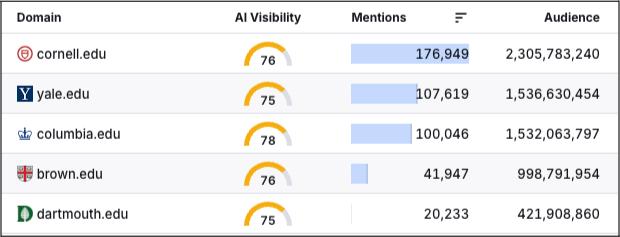
- The Gap: Yale is currently generating 107,619 mentions, while Cornell has surged to over 176,900.
- The Reach: This volume gap results in a "reach deficit" of nearly 800 million potential audience impressions compared to the leader.
- The Insight: Yale has the authority (Score: 75), but it lacks the footprint (Mentions) to dominate the AI narrative.
The Data Conflict
When we look at the raw numbers, the paradox becomes clear. Despite Yale’s high authority, Cornell maintains a staggering 70,000-mention lead across AI models. To put that in perspective, while Yale is "authoritative," Cornell is "present."
AI models like ChatGPT, Claude, and Gemini aren't just looking for the most trusted source, they are looking for the most cited and most accessible data points to satisfy a user's query.
The Frequently Trap
The paradox exists because AI models are trained on vast datasets where frequency often mimics importance. Traditional SEO rewards the "quality" of a single landmark.
Cornell’s massive visibility isn't necessarily because their individual pages are "better" than Yale’s, it’s because they have created a larger digital footprint that AI models can easily ingest, categorize, and repeat. Yale is operating with a "Quality over Quantity" mindset in a medium that currently prioritizes relevance through repetition.
Yale's Performance Overview
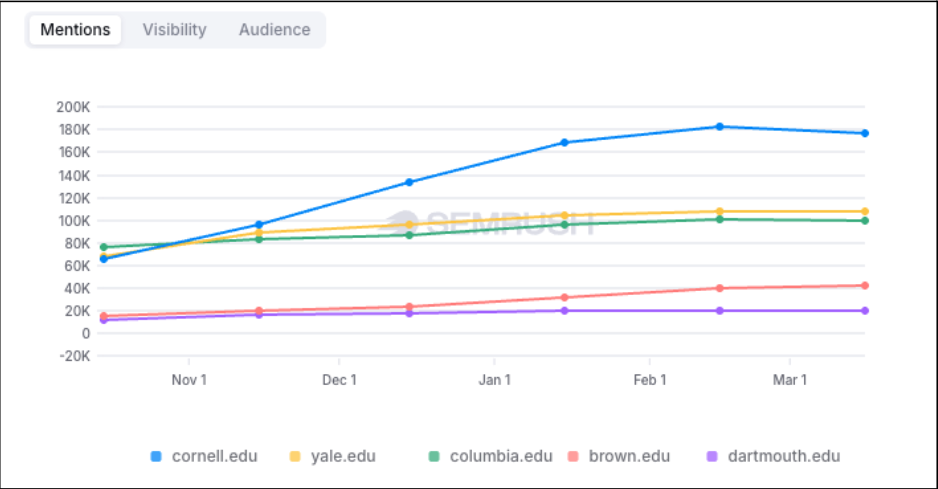
Our analysis revealed that Cornell outpaces Yale by over 70,000 mentions across major AI models (ChatGPT, Claude, and Gemini). A minor statistical outlier? No, it’s a difference in how these models perceive the "relevance" of each institution.
While Yale sits on its mountain of prestige, Cornell has built a massive digital surface area. The result? A massive mention deficit for Yale. If you aren't being mentioned, you don't exist in the user's considered set.
Why Cornell is Winning the "Volume War"
Cornell’s dominance isn't an accident of brand, it’s an achievement of data density.
- The Sports Gateway: Cornell leverages high-frequency, structured data (like sports schedules, real-time scores, and athletic bios) to create a constant stream of "citable" information.
- The "Always-On" Signal: While Yale’s content often leans toward evergreen, static prestige, Cornell’s digital footprint is "noisy" in the best way possible. By providing structured, frequently updated data points, they give AI models more "hooks" to grab onto during training and real-time retrieval.
- Relevance Through Repetition: AI models equate frequency with utility. Because Cornell’s data appears more often in the datasets AI models use to "learn" the world, the AI views Cornell as a more "active" and therefore more "relevant" source to serve to users.
Yale’s performance proves that a high Domain Authority is no longer a shield against irrelevance in AI search. You can have the most authoritative site in the world, but if your competitor is providing 70,000 more citable data points, the AI will choose the competitor every time.
Strategic Observation (Yales Struggles)
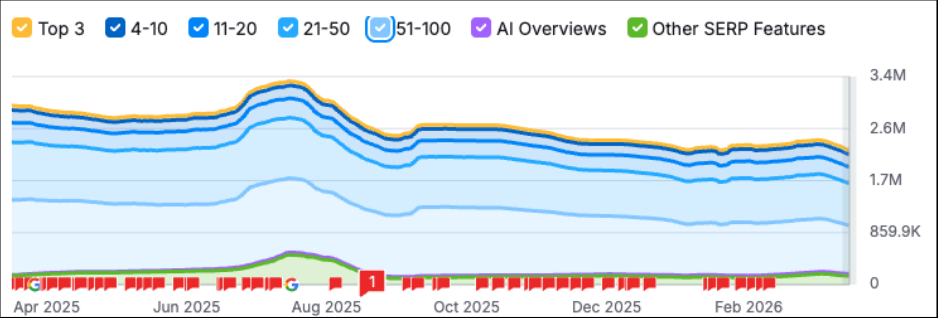
Below is an image of a 12-month keyword position report reveals a steady, compounding erosion of Yale’s organic footprint. This isn't just a traditional SEO slump, it’s the visual evidence of a prestigious brand losing its "handshake" with modern AI retrieval systems. While Yale possesses immense historical authority, its digital execution is creating friction for the very LLMs that now dictate brand visibility.
1. The Subdomain Fragmentation
One of the most significant hurdles identified in our research is Yale’s Segmented Content Model. Unlike competitors who have consolidated their authority into a unified subdirectory structure (like university.edu/law), Yale’s digital presence is fractured across dozens of disparate subdomains:
- art.yale.edu
- law.yale.edu
- medicine.yale.edu
- engineering.yale.edu
From an Entity Intelligence perspective, this creates a disjointed approach. AI models like Gemini and ChatGPT prioritize "Entity Clarity." By siloing high-value research and academic programs across different domains, each with inconsistent UX elements and varying navigation structures, Yale dilutes its root domain signal. This forces AI agents to piece together the "Yale Entity" from fragments rather than a single, authoritative source, ultimately leading to lower confidence scores in AI-generated answers.
2. Content Velocity vs "Static Authority"
AI visibility in 2026 is heavily influenced by publishing cadence and freshness. Our analysis of page production across the main domain and its subdomains reveals a "Static Authority" problem.
- The Cadence Gap: While Yale maintains deep archival content, the production of new, AI-optimizable content (such as blog insights, active program updates, and research summaries) is inconsistent.
- The Freshness Signal: AI Overviews favor domains with a "High-Frequency Pulse." Sites that update key pages or publish new insights at a higher weekly cadence are significantly more likely to be cited. Yale’s current publishing cycle across domains, often tied to formal academic bulletins, is too slow to maintain "Active Relevance" in a search environment that rewards real-time authority.
3.Lack of Alignment for AIO Standards
Traditional SEO focuses on keywords and backlinks, but AI Optimization (AIO) requires a structural shift. Yale’s technical architecture currently lacks the specific alignment needed for machine synthesis:
- Schema Underutilization: Modern AIO requires deep "Entity Schema" and FAQ markup to act as a grounding truth for AI models. Many of Yale’s subdomains lack a unified structured data layer, making it difficult for AI crawlers to parse the relationships between different departments and programs.
- The Architecture Barrier: Fragmented site structures often lead to crawl budget inefficiencies. As AI-specific bots (like OAI-SearchBot) become the primary "readers" of the web, sites that aren't technically streamlined for high-speed indexing effectively become invisible to the models' training sets.
4. The Authority Paradox Confirmed
This research confirms the central thesis of the "70,000-Mention Gap." Yale is operating under the assumption that historical prestige equals digital presence. However, in the age of Generative Search, prestige is no longer a proxy for visibility. Without a transition toward a unified domain architecture and a high-velocity, AIO-aligned content strategy, Yale will continue to see its traditional authority overshadowed by more digitally agile competitors.
Reclaiming The Narrative Through AIO
As AI-driven search becomes the primary lens through which prospective students, researchers, and donors interact with the web, "passive prestige" is no longer a viable strategy.
Our approach to Higher Education marketing is built on the reality that AI models prioritize structured reliability over historical authority. To help Yale, and institutions like it, reclaim their share of voice, we focus on three strategic pillars:
- AIO-Engineered Data Architecture: We don’t just optimize for keywords, we optimize for LLM ingestion. By implementing sophisticated Schema markup and structured data hubs, we ensure your institution’s "facts" from faculty research to campus life, are the first ones the AI grabs.
- Performance-Driven Content Scaffolding: Volume matters, but strategic volume wins. We identify the high-intent academic "silos" where your visibility is lagging and deploy content clusters designed to trigger AI citations, effectively turning your "academic blind spots" into brand strongholds.
- Integrated Performance Marketing: AIO does not live in a vacuum. We sync your organic AI visibility with hyper-targeted paid media. By using the insights from our AI visibility audits, we direct your performance marketing spend toward the specific gaps where your competitors are currently out-shouting you.
In the age of AI, authority is earned every time a model generates an answer. It’s time to ensure your institution is the one being quoted.