
Harnessing AI to Strengthen Your Higher Education Content Marketing: A Step-by-Step Guide
Educational institutions are more pressed than ever to deliver high-quality, relevant content that not only meets the needs of prospective students, families, alumni, and internal stakeholders but also helps them stand out among competitors in search engines, including generative AI search. But keeping pace with demand—while ensuring your content marketing plan is strategic, comprehensive, and optimized—can be challenging for even the most experienced teams.
This is where AI marketing tools for higher education can make a powerful difference. From identifying topic gaps on your website and marketing materials to generating keyword insights, AI marketing tools for higher education can streamline the content development process and help institutions get more done in less time. When used strategically, AI becomes a catalyst for quickly uncovering essential content opportunities that elevate visibility, improve search performance, and better serve users.
Below is a practical, step-by-step guide to using AI to identify, validate, and prioritize higher ed content opportunities for your institution.
1. Use AI to Identify Topic Gaps on Your Education Website
Before creating new content, it’s essential to understand what your website is missing. Most colleges and universities manage large, complex websites with many contributors across departments. This often results in outdated pages, thin content, or missing information that prospective students and families actively search for.
AI tools can significantly accelerate this discovery phase. An AI site auditing tool (see example from Semrush, below) or a customized LLM agent can:
• Categorize your existing content by program, audience, or topic
• Highlight thin or outdated pages
• Surface missing information students and families expect to find
• Compare your content inventory against competitor sites to uncover missed opportunities
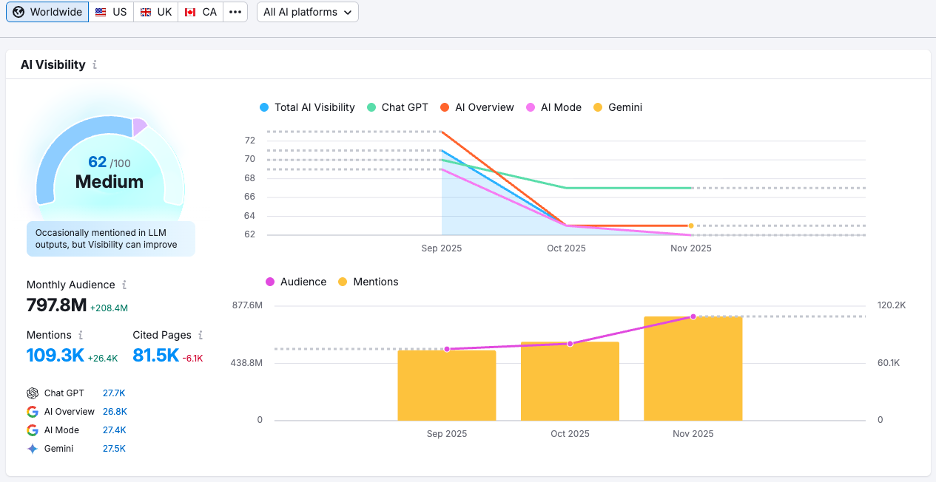
For example, while a competing institution may publish robust content on “career paths for computer engineering majors,” capturing many prospective students seeking this area of study in search, your site may cover only program requirements. AI-driven gap analysis highlights these disparities quickly and accurately—with the right prompting.
By identifying these gaps, you gain clarity on where your content needs the most attention and where new opportunities lie.
By the time you finish reading this, you’ll not only understand query fan-out but also have a clear plan for shaping your content so it gets noticed where it counts.
Interested in a custom agent to support your content strategy? ZenSource can help.
2. Use an AI Content Generator to Uncover Topics for Key Audiences
After identifying your content gaps, take the following steps to discover the topics that align with your user intent and the goals of your college or university.
- Traditionally, this part of the process required extensive manual research, but here is where you want to use an agent or workflow to dramatically simplify your workload. Your agent can ideate topics and validate their search potential all at once by integrating an SEO tool, such as Semrush.
- Once you have identified the model you plan to use, or have a developer to build you a custom agent, you can begin your topic ideation. Start by grounding (feeding) your tool with essential documents about your audience and their needs. Think: personas and journey maps, and examples of existing content that clarify your audience’s intent.
- If there are certain goals for this content, whether fundraising-related, increasing enrollments in a certain academic department, or increasing engagement with, say, parents of prospective students, provide your agent or workflow with specific directional requests in your prompt.
- Also consider whether you will ultimately require an output of new content from your AI. If so, will it be text-based only, or will you need images or video? Provide all of the necessary content types to inform this process so your end result will include all necessary elements.
- Instruct the model to seek topics and potential keywords that align with your content strategy. Test it out and iterate until you receive the output you’re looking for. You can then re-use your agent each time you begin your content creation process, tweaking the prompt if needed.
3. Cross-Reference Against Existing Content
Another important step to take before developing new content is to ensure your emerging ideas aren’t already addressed elsewhere on your website. AI tools excel at this step by cross-referencing your proposed topics with existing published pages to verify originality and avoid redundancy. This can be done as the second step in the agent’s process, but include it in your single prompt in order to get one comprehensive output. This will save you from having to return with additional prompts to get what you need, like in a traditional chat.
Set up your AI-driven content comparison tools to:
- Scan your website or sitemap for articles or pages related to your new topical ideas and potential keywords
- Identify where similar topics may already be partially covered
- Evaluate the depth of existing content
- Recommend whether to build a new article or expand a current resource
For example, if your AI content generator suggests the keyword “MBA scholarship tips,” the system may recognize that your site already includes a financial aid FAQ addressing parts of this topic. Instead of creating a new post, you may decide to expand that FAQ or create a more comprehensive guide that enhances and consolidates existing content.
This approach ensures you focus your time on producing content that adds real value, fills genuine gaps, and strengthens your overall topical authority—reducing inefficiencies and improving the user experience.
4. Lean on an AI Keyword Generator to Do the Busy Work
With the right SEO integration, your AI tool can go a step further and analyze search behavior, emerging trends, and keyword volume. This way, the output contains ideas not already covered on your website that are also data-driven to offer the best search opportunity. This is where your plug-in comes into play.
- AI-powered keyword ideation can help you:
- Discover relevant long-tail keywords and search phrases. Some tools can even take AIO into account and offer LLM questions to incorporate
- Understand user intent behind queries
- Identify trending topics within academic programs or admissions
- Organize topic areas into related keyword clusters for more strategic content planning
For example, if you’re promoting a new data analytics program, an AI keyword generator may recommend topics such as:
- “data analytics degree jobs”
- “is a data analytics major worth it”
- “data analytics vs data science programs”
Not all keywords are created equal, and it’s essential to ensure the topics you pursue have meaningful search volume and achievable competitiveness.
You’ll need to select the necessary criteria for your plug-in. Modern SEO platforms—many powered by AI—provide you with:
- Search volume for primary and secondary keywords
- Keyword difficulty and competitiveness
- Traffic potential based on related terms
- SERP features that might influence visibility
For example, exploring the keyword “RN to BSN program online” may reveal related, less competitive terms like “benefits of a BSN degree” or “BSN nursing career paths,” offering high-value content opportunities with clearer ranking potential.
Validating keywords ensures your content strategy is grounded in data rather than guesswork. It also helps you prioritize high-impact ideas, making your editorial planning more effective and aligned with real user demand.
Once you have this output, you can feed your content calendar with data-backed content ideas that support SEO performance and audience relevance. You can even have your agent add ideas to your calendar for you once you get to the approved stage of the process.
Thinking ahead, perhaps you build your agent—or simply use an AI chat, such as ChatGPT or Google Gemini—to help you quickly outline or draft your content based on these keywords—making the content production process more efficient.
Governance is Key to Leveraging AI in Your Content Marketing Strategy
Now that you have a robust AI integration in your content workflow, it’s imperative that you establish the necessary guardrails to ensure security and quality. Include the following governance practices in your process:
- If you are working with proprietary content, audience data, or any other sensitive information, use a paid tool that provides security. Also consider which individuals have access to your tools, who is overseeing usage, and how you will monitor AI usage to maintain ethical standards and up-to-date software.
- To support accurate content creation, provide the AI with your institution’s brand guidelines in order to produce a piece of content that’s in your brand voice.
- Finally, make sure you are reviewing the content with a human subject matter expert and editor before publication to ensure it aligns with the offerings of your institution and is up to the same quality as any other piece of content you would typically publish.
When it comes to marketing in higher education, you’re facing increasing pressure to produce diverse, high-quality content for audiences at every stage of the decision-making process that drives website traffic. AI content generators and AI keyword generators can work in tandem by developing an agent capable of handling this robust multi-step process from end to end in a single prompt. This accelerator can give education marketers a powerful advantage, helping you uncover what matters most to your users and deliver it with precision.
By identifying topic gaps, generating strategic keywords, ensuring new ideas aren’t duplicative, and validating opportunity with SEO data, your institution can build a more efficient, scalable and effective content marketing strategy. AI empowers your team to focus on strategy and creativity—while automating the heavy lifting behind research and analysis.