
For most organizations today, a CRM is much more than a database. It’s the system that connects marketing, operations, and the entire constituent journey.
At Primacy, we focus on making sure your CRM works as the central hub it’s meant to be. That means connecting it to the rest of your technology stack so data flows freely, marketing teams can personalize experiences, and technical teams can trust the underlying architecture.
Whether you're working in the specialized world of Technolutions Slate for higher education or the broader enterprise ecosystem of Salesforce, our goal is the same: turn your CRM data into something that actively drives better engagement and smarter decisions.
Salesforce: Building a True 360° View
We approach Salesforce as an enterprise platform, not just a system for tracking sales.
Our focus is on creating a unified data layer where marketing, operations, and IT all have access to the same information and context.
Marketing Cloud & Health Cloud Integration
Many organizations struggle to connect Salesforce Marketing Cloud with their websites and content platforms. We help bridge that gap by integrating SFMC with CMS platforms like Drupal [link to Drupal services], Sitecore [link to Sitecore services], or WordPress [link to Wordpress page] so behavior on the website can trigger personalized journeys in real time.
For healthcare organizations, we also work with Health Cloud, ensuring implementations are designed with HIPAA compliance in mind while still enabling streamlined data flow , patient acquisition and communication.
Custom Web Components and Integrations
Out-of-the-box Salesforce functionality is powerful, but it doesn’t always meet complex business needs. When that happens, our developers build custom Lightning Web Components and APEX integrations that extend Salesforce functionality into internal portals, external applications, or public-facing experiences.
Bi-Directional Data Sync
A lot of integrations stop at basic “form-to-lead” connections. We take it a little bit further by designing reliable, middleware-supported integrations that keep data moving both ways.
This means sales and service teams can see the full history of a customer’s digital interactions not just a single form submission. We recently rolled out a similar integration with NetSuite ERP to extend this visibility into financial and operational data as well.
Maximize Your HubSpot Investment
As a strategic partner, Primacy bridges the gap between HubSpot’s out-of-the-box features and your complex enterprise needs. We provide end-to-end support—from technical migrations and API-led integrations to advanced RevOps reporting. Whether you are looking to sync HubSpot with an ERP like NetSuite or build a seamless data flow between your website and Marketing Hub, we ensure your platform is optimized for performance, data integrity, and measurable ROI.
Slate: Engineering for Higher Education
For higher education institutions, Slate has become the standard platform for admissions and advancement. But many schools only scratch the surface of what it can do.
We help institutions take Slate beyond the default setup and turn it into a flexible platform that supports sophisticated recruitment and engagement strategies.
Custom Portal Development
Slate can power much more than admissions forms. We build custom portals for students, faculty, and alumni that feel like a seamless extension of the institution’s primary website.
By leveraging Slate’s APIs and web services, we create dynamic experiences that go far beyond static landing pages.
Configurable Joins & Data Modeling
Slate’s data model is powerful but can become complex quickly. Our team helps institutions design clean, well-structured queries and joins so communications, segmentation, and reporting are based on reliable data.
This ensures that automation and outreach are triggered by meaningful events, not messy data structures.
SEO for Slate Landing Pages
A common challenge with Slate is that many pages live on subdomains that aren’t always optimized for search or performance. We work with institutions to improve SEO, page performance, and overall user experience so the transition from the main .edu site into the admissions funnel feels seamless.

The Integration Engine: Connecting the Stack
A CRM becomes truly valuable when it’s connected to the rest of your systems.
Much of our work focuses on building the integration layer that ties everything together.
Rather than relying on simple point-to-point integrations, we design architectures that manage data flow intentionally.
Depending on the environment, this may involve platforms like MuleSoft or Dell Boomi, or custom middleware built with Node.js and AWS Lambda.
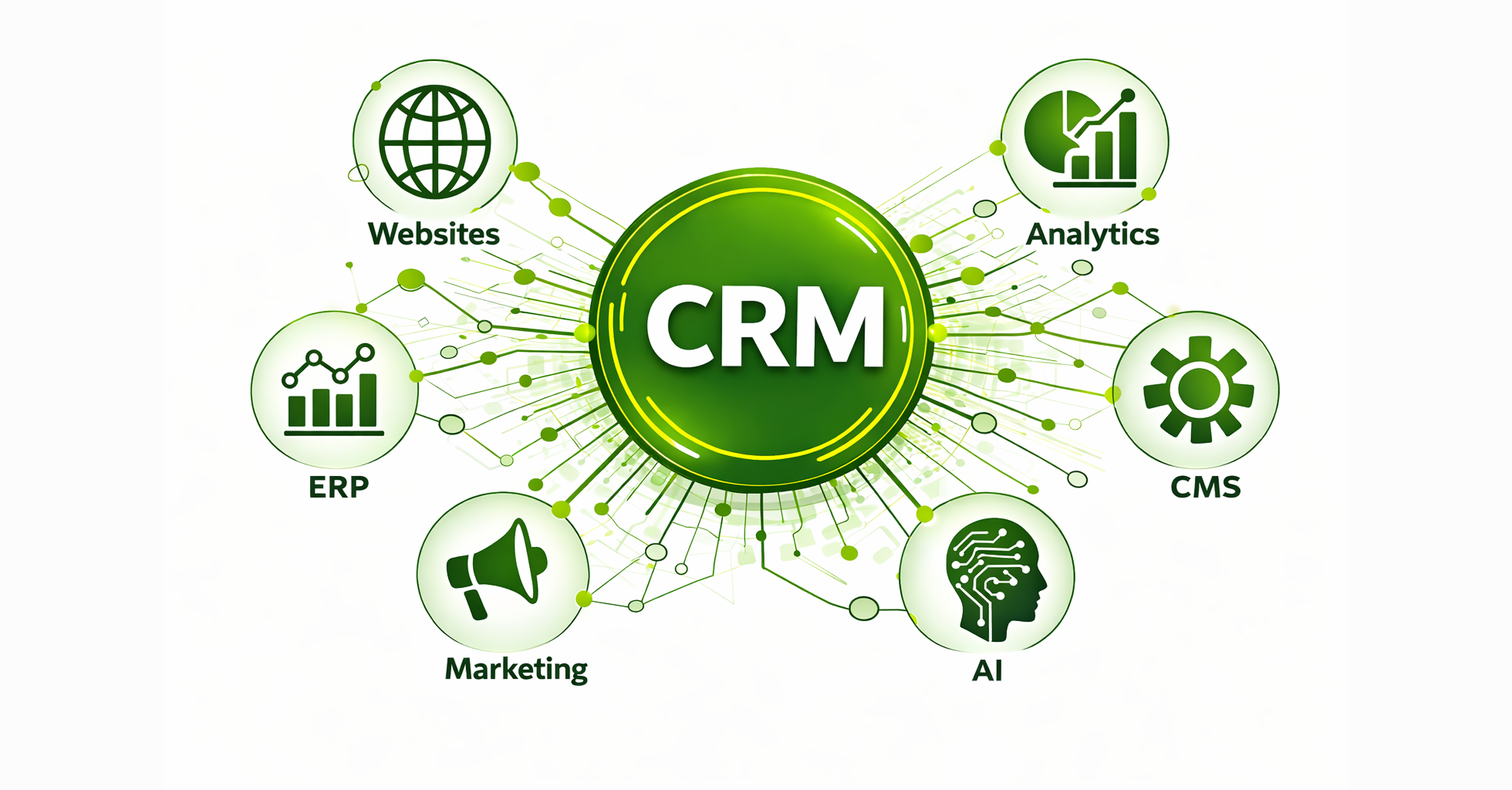
These integration layers allow CRM systems to communicate with:
CMS platforms, enabling personalized website experiences based on CRM data
ERP and SIS systems, such as Banner, Colleague, or SAP
Payment systems, supporting secure tuition payments or donation flows within the CRM journey
AI platforms, such as Amazon Bedrock, enabling intelligent automation, predictive insights, and AI-driven personalization using CRM data.
The goal is simple: make sure the right data reaches the right system at the right time.
Systems integration doesn’t just improve operations it also unlocks better marketing intelligence.
By connecting CRM data with analytics platforms like GA4 or BigQuery, we help organizations create closed-loop attribution models.
This allows marketing teams to understand the full lifecycle of a user from their first anonymous website visit to a final application, enrollment, or conversion.
With that visibility, marketing spend becomes much easier to optimize.
Any integration strategy needs to prioritize security and data integrity from the start.
Our approach emphasizes governance and reliability at every layer in integration workflow.
We implement secure authentication using SAML or OAuth-based Single Sign-On so users can access multiple systems without compromising security.
Integration endpoints are continuously tested to ensure data mappings remain accurate, even as APIs or downstream systems evolve.
We design integrations with privacy and regulatory compliance in mind, supporting requirements such as GDPR, CCPA, and FERPA.
Modern Data & Marketing Platforms
Today’s marketing and CRM ecosystems extend well beyond a single platform. Many organizations are building unified data environments using tools like Salesforce Data Cloud, HubSpot, or Treasure Data CDP to bring together customer information from websites, CRMs, support systems, and marketing tools. The goal is simple: create a single, reliable view of each customer so teams can deliver more relevant experiences across every channel.
We also help teams operationalize this data using modern automation platforms. Tools like Zapier and Salesforce Agentforce allow organizations to connect systems quickly, automate workflows, and even introduce AI-driven agents that can assist with customer engagement, internal operations, and data management. These integrations help reduce manual work and ensure data flows smoothly across the entire technology stack.
For higher education and mission-driven organizations, platforms like Slate remain central to admissions and advancement workflows. Our team helps institutions connect Slate and manage Slate with marketing platforms, analytics systems, and CRMs so recruitment and engagement data can be used more effectively across the institution.
Marketing Automation & Engagement Channels
A strong CRM foundation also supports more effective marketing execution. We work with marketing teams to connect their CRM data with platforms like Iterable and SMS marketing tools, allowing them to orchestrate coordinated campaigns across email, mobile messaging, and web channels.
These integrations also strengthen paid media strategies, enabling better audience segmentation and more precise targeting. By connecting CRM and CDP data to advertising platforms, organizations can create smarter lookalike audiences, retarget engaged users, and measure the true downstream impact of campaigns.
The result is a marketing ecosystem where data, automation, and messaging all work together helping organizations reach the right people with the right message at the right time.
Ready to Make Your CRM Work Smarter?
Your CRM should be one of your most valuable systems not a disconnected data repository.
With the right architecture, integrations, and governance in place, platforms like Slate and Salesforce can become powerful engines for engagement, marketing insight, and operational efficiency.
If you'd like, we can start with a Technical Discovery session to review your current CRM architecture, identifyintegration gaps, and outline opportunities for improvement.