
AI-Powered Search: Making Sites Smarter with OpenSearch & AWS Bedrock

Most enterprise search experiences still rely on keywords and forms. That worked fine when content as small and users knew exactly what they were looking for. But today? People search in full questions using Natural Language queries. They expect Google-level intelligence. They expect answers, not links.
Traditional search can’t understand intent. It can’t recognize that “eco-friendly strategy” and “sustainable business practices” mean the same thing. And it can’t summarize 12 articles into one clear answer. That’s where AI-powered semantic search changes everything.
By combining Drupal, OpenSearch, and AWS Bedrock (AI), organizations can move from basic keyword lookup to something far more useful: search that actually understands meaning.
What Actually Changes with Drupal AI Site Search?
Instead of indexing content by keywords alone, we generate what are called embeddings.
Think of embeddings as a mathematical representation of various data sources. When you publish a piece of content in Drupal, AWS Bedrock (using AI models like Titan Embeddings) converts that content into a vector-based number representation. That vector captures what the content is about, not just the words it contains.
So when someone searches for: “eco-friendly company strategies”, the system understands that it’s conceptually related to:
- sustainable business practices
- carbon reduction planning
- renewable energy investments
- ESG initiatives
It’s matching ideas, not strings of text. That’s a big leap forward.
From Search Results to Real Answers
The next step is where things get interesting. Once OpenSearch finds the most relevant content using vector similarity, we can layer in large language models (LLMs) from AWS Bedrock, such as Claude, for AI intelligence and guidance.
Now instead of returning ten blue links, the system can:
- Pull relevant documents
- Generate a concise summary
- Cite internal sources
- Suggest related questions
- Guide users toward next actions
For example, a user searching: “Compare renewable energy options”
Might receive:
- A short summary comparing solar, wind, and hydro
- Links to deeper content
- Relevant case studies
- Suggested follow-up questions
It feels less like browsing and more like having a conversation with your knowledge base.
What Drupal AI Search Means in the Real World
AI search doesn’t just help users – it empowers content authors. It helps the people managing content too.
- Users find what they need faster, reducing search abandonment
- AI can suggest metadata and tagging
- Related content recommendations become smarter
- Multilingual content becomes searchable across languages
Your content works harder without your team working harder.
What about IT teams? This isn’t a fragile experimental stack. OpenSearch is an enterprise technology and can handle large-scale indexing and vector search. AWS Bedrock provides managed AI models that align with enterprise compliance standards. Everything runs in a scalable, cloud-native architecture.
It’s built to handle:
- Millions of documents
- Sensitive environments
- Predictable cost structures
- Continuous model improvements
No custom model hosting. No infrastructure headaches.
And for Business Leaders the impact is often bigger than expected. Employees spend less time searching. Customers get better answers. Support teams see fewer repetitive questions. Content investments start delivering measurable ROI.
In many cases, organizations using AI power search can expect:
- Faster content discovery
- Fewer support queries
- Higher engagement with existing resources
- Stronger overall user satisfaction
And importantly, it positions your organization as modern and intelligent rather than static and outdated.
What the Architecture Can Look Like
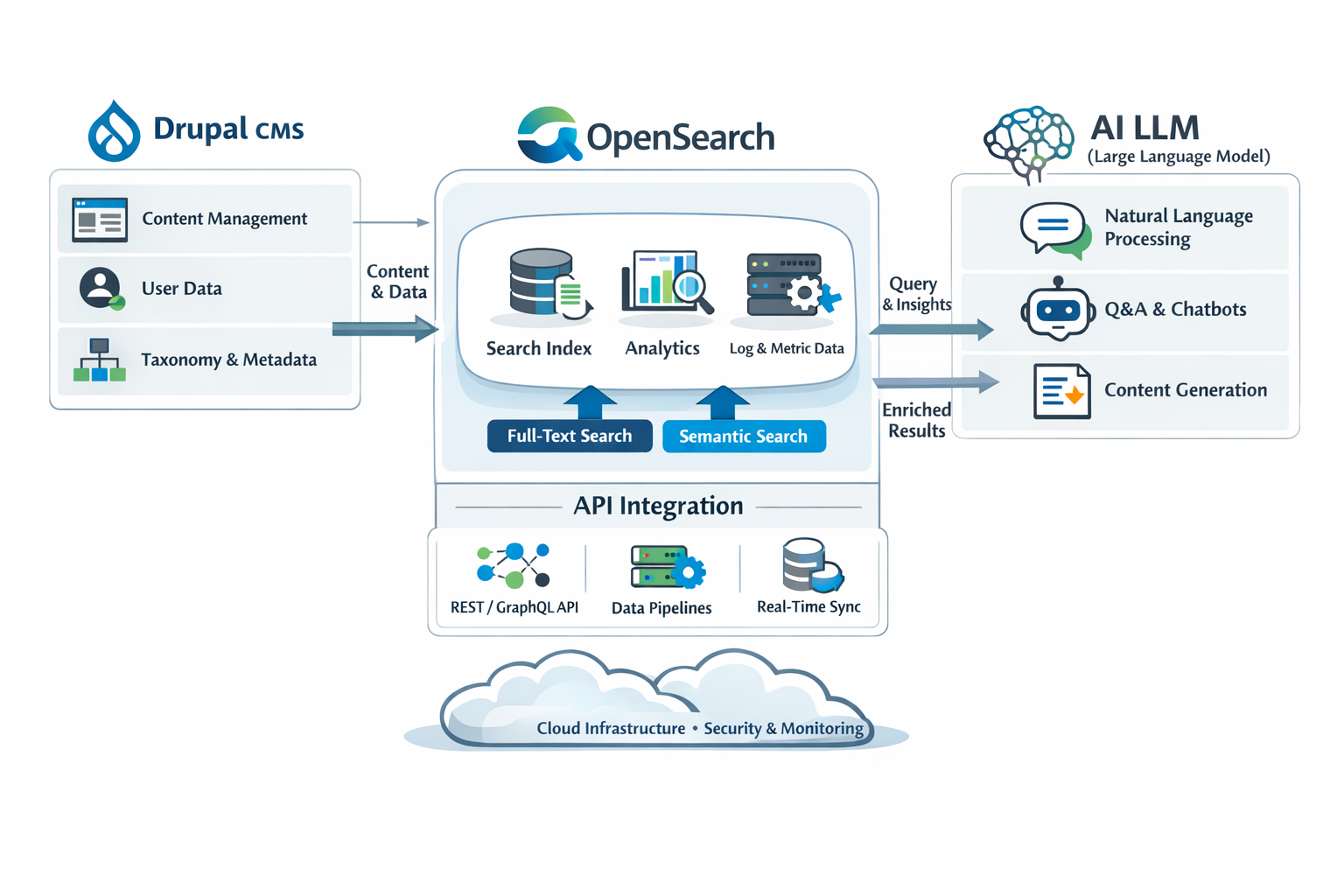
At a high level:
- Drupal remains your content hub
- OpenSearch stores both traditional indexes and vector embeddings
- AWS Bedrock provides the AI models for embeddings and answer generation
Drupal publishes content and embeddings are generated. OpenSearch handles similarity search while Bedrock models generate intelligent summaries. And the user sees a clean, intuitive search experience. Under the hood, it’s sophisticated. On the surface, it feels simple.
The Impact of AI Site Search Functionality
Healthcare
Patients searching “chest pain causes” receive structured summaries, relevant articles, and clear next steps instead of an overwhelming list of links.
Financial Services
Compliance teams can ask complex regulatory questions and receive synthesized answers with citations to internal policies and documentation.
Higher Education
Students researching “climate change impact on agriculture” can see summarized research themes, related datasets, and faculty expertise in one place.
In each case, search moves from retrieval to understanding.
Getting Started Doesn’t Take Months
Most organizations begin with a focused proof of concept. Week one might involve embedding and indexing a subset of content. Next, semantic search is layered into a defined section. Then answer generation is introduced for common queries. Within a few weeks, stakeholders can see the difference ands from there, it scales.
You’ve already invested heavily in content creation. AI-powered search ensures that investment doesn’t sit buried behind weak keyword logic. Instead, every article, document, and resource becomes easier to discover and more valuable to users.
This isn’t about replacing Drupal. It’s about unlocking what Drupal already holds. Search is no longer just a utility feature. It’s becoming the front door to your entire digital experience. And increasingly, users expect that door to be intelligent. Interested in making your site smarter?