
Accelerate Your Healthcare Content Marketing with AI
Healthcare marketers operate in one of the most complex and challenging digital environments today. Patients, caregivers, clinicians, and consumers need clear, trustworthy, and accessible content while search engines prioritize depth, authority, and relevance. At the same time, healthcare organizations face regulatory constraints, decentralized content ownership, and limited marketing resources.
Meeting these demands consistently is no small task. This is where AI marketing tools for healthcare can help you meet your goals. From uncovering content gaps to streamlining keyword research, AI content creation tools can help you move faster to get from ideation to execution. When applied strategically and securely, AI allows teams to identify high-impact content opportunities that improve visibility, patient engagement, and search performance across traditional and generative AI search experiences.
Below is a practical, step-by-step framework for using AI to identify, validate, and prioritize essential content opportunities in healthcare marketing.
Interested in integrating AI to support your healthcare content strategy?
1. Expedite Your Healthcare Website Audit with AI
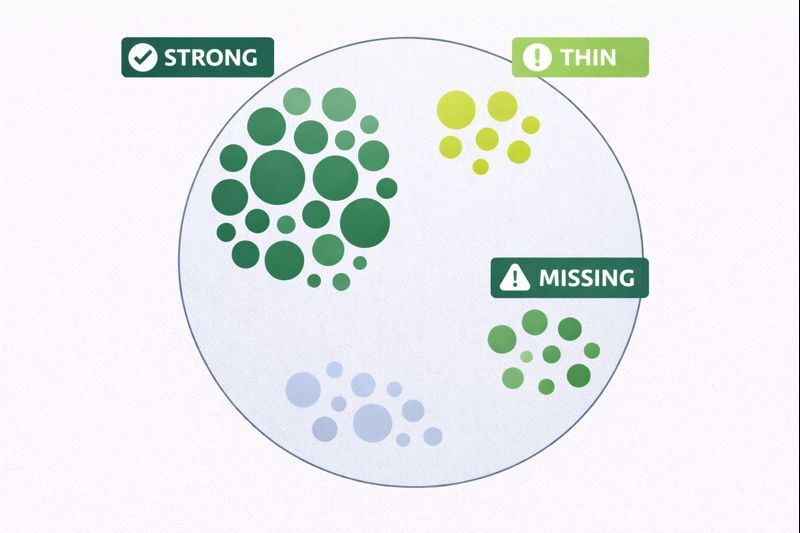
Before creating new content, healthcare marketers must first understand what information is missing—or insufficient—across their digital ecosystem. Healthcare systems often have large, fragmented websites maintained by multiple service lines and departments, which can lead to inconsistent coverage of conditions, treatments, and patient stories.
AI-powered site auditing tools like Ahrefs can quickly analyze your content landscape and surface gaps by:
- Sorting existing content by service line/specialty, or audience
- Identifying outdated, thin, or underperforming pages
- Highlighting missing content that patients commonly search for
- Providing strengths and weaknesses of your content compared with competitors or industry leaders
For example, a competing health system may rank strongly for content related to “minimally invasive spine surgery,” while your site only includes a high-level service description. With the right prompting at the outset, an AI-driven gap analysis can reveal these missed opportunities quickly and at scale.
First identify where your content falls short, so you can focus resources on areas that will most improve patient experience and search visibility.
2. Provide AI with Essential Information to Fuel Ideation
Once content gaps are identified, the next step is ideating a wealth of topics that align with user intent and organizational goals to feed your content calendar for several months, or the year to come. Historically, this required time-intensive research across search tools, internal data, and subject matter experts. By developing an AI keyword generator agent, you can dramatically streamline this process.
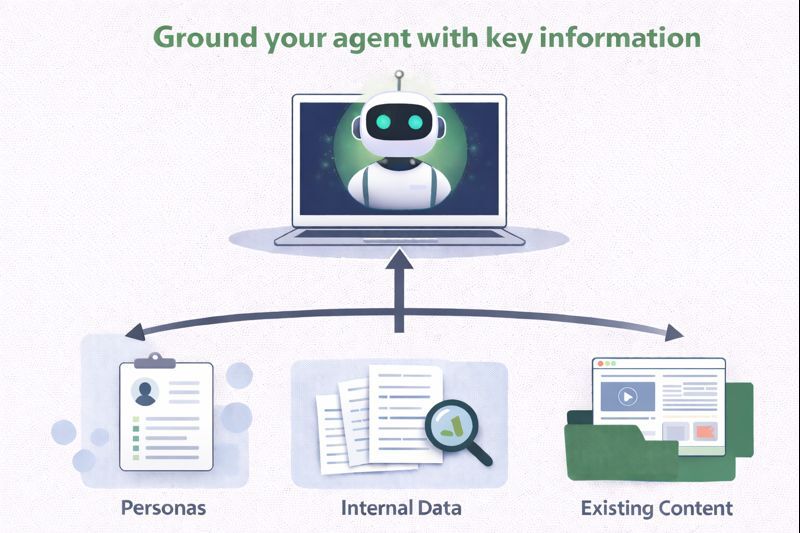
To truly make this process seamless, you’ll want to use an API to connect your AI model with an SEO platform such as SemRush. This way, you can ideate topics and validate their search potential simultaneously. Start by grounding your AI with key inputs such as:
- Insightful results from your gap analysis in Step 1 that should inform topic ideation
- Patient personas and care journeys
- Common questions from providers and your website’s search
- Existing service line information and blog content
- Strategic priorities (e.g., growth in cardiology, better findability for orthopedics, or expansion of women’s health)
You should also clarify whether your AI content creation process will ultimately support blogs, condition pages, FAQs, videos, or visual explainers. Providing this context upfront allows the AI to generate topics you can actually implement.
For example, if your goal is to grow awareness for a new outpatient surgery center, an AI keyword generator might surface topics such as:
- “outpatient surgery vs hospital surgery”
- “same-day surgery recovery tips”
- “is outpatient surgery safe for older adults”
Using AI in this way can give healthcare marketers a quick and repeatable way to generate a massive number of content ideas aligned with patient needs and business objectives. After all, you aren’t going to run with every idea that’s proposed, but the more you specify your needs, the better your output will be.
3. Get More Data to Make More Informed Decisions
With the right SEO integration, your AI agent can also analyze search behavior, emerging trends, and keyword volume automatically—saving you hours of manual work. It allows you to move beyond intuition and base decisions on real search data, so make sure it’s accessing all the data you need to do so.
An AI-plug in can provide:
- Relevant long-tail and question-based keywords
- Search volume and competitiveness
- Traffic potential, including local search traffic
- SERP features that may influence visibility
- Trends from generative AI search
- Emerging healthcare topics and treatments
- Keywords organized into strategic topic clusters
For example, a healthcare organization focused on orthopedics might uncover keyword opportunities such as:
- “knee replacement recovery timeline”
- “physical therapy after knee surgery”
- “alternatives to knee replacement”
After digging up tons of new content ideas, you want to validate them with all of the data your agent can gather to ensure your content strategy prioritizes high-impact opportunities that balance patient value with discoverability in traditional and generative search.
4. Ensure Your New Ideas Are … New
Before jumping in and producing new content, it’s critical to cross reference existing content to make sure your ideas aren’t already addressed elsewhere on your site. Healthcare websites frequently contain overlapping condition pages, blog posts, and educational resources—often written at different times by different teams. The last thing you want to do is use your precious resources creating a new page on the same topic that already exists.
Remember: this isn’t actually an extra step for you. Bake this request into the the same prompt for your AI model. It will cross-reference all of its recommendations against your existing content to ensure originality and efficiency. In this part of the prompt, you want to configure your AI agent or workflow to:
- Scan your sitemap or content repository for related topics
- Identify partial or full coverage of proposed ideas
- Evaluate the depth and quality of existing content
- Recommend whether to expand, consolidate, or create net-new assets
For instance, if your AI keyword generator surfaces “managing diabetes during pregnancy,” the system may recognize related gestational diabetes content already on your site. Rather than suggesting you publish a redundant article, it may suggest you enhance an existing page with new sections or patient-friendly explanations.
This approach ensures that every piece of content adds value, strengthens topical authority, and improves the overall patient experience. Once you’ve used human oversight to decide which topics to pursue, make sure to update—or let AI update—your content calendar.
At this point, you may continue to lean on AI, such as ChatGPT or Google Gemini—to help you quickly outline or draft your content based on your content goals and keywords, making the content production process more efficient. If you have a strong need for AI as an accelerator in the writing process, you might build a separate content generator agent that deeply understands your content needs and goals, to draft blog posts that are in sync with your brand voice. And don’t forget to implement a rigorous review process.
Security is a High Priority When Using AI in Healthcare Marketing
As healthcare marketers integrate AI into their content workflows, governance is non-negotiable. Patient trust, compliance, and accuracy must remain at the forefront.
Best practices include:
- Using secure, paid AI tools that will ensure privacy when working with proprietary or sensitive data
- Defining access controls and oversight for AI usage within your organization
- Providing brand, tone, and compliance guidelines to AI tools if leveraging for assistance with written content
- Requiring human review by subject matter and editorial experts before publication
AI content creation should enhance—not replace—clinical expertise and editorial judgment.
If you want to make your content planning more strategic and keep up with the needs of your audience but don’t have the resources, a customized AI agent can improve your visibility in traditional SEO and generative search environments. It can leverage a single workflow to support research, ideation, validation, and planning—dramatically improving efficiency.
By identifying topic gaps and competitive opportunities, generating audience-aligned ideas, validating opportunities with SEO data, and ensuring new content isn’t duplicative, you can build a more scalable and effective content marketing strategy for your healthcare website.